Real-world measurement tools can anchor your PBR materials to physical reality - here's how a gloss meter fits into that workflow.
Why Be Scientific About It
The more grounded a material is in real-world values, the more convincing it tends to read - even when it's fictional. Even alien-like materials in games follow the logic of how we perceive and author the world, just with modifications. An alien weapon material could be carbon fiber with a hint of thin-film interference applied to it. The starting point is still based on real-life. Everything in art is somehow derived from real-life examples, and measurement tools are one way to make this based on ground-truth rather than approximating.
What a Gloss Meter Actually Measures
Gloss meters are common in automotive and manufacturing - used to check whether surface imperfections are causing inconsistency in a panel's gloss value. For material artists, the same tool works as a reliable scientific indicator for surface values that would otherwise be estimated by eye.
A gloss meter measures surface reflectivity in gloss units (GU) at a defined angle - 60° is the standard for most surfaces. As a rough reference:
- Matte surfaces: < 10 GU
- Semi-gloss: 10–70 GU
- High gloss: > 70 GU
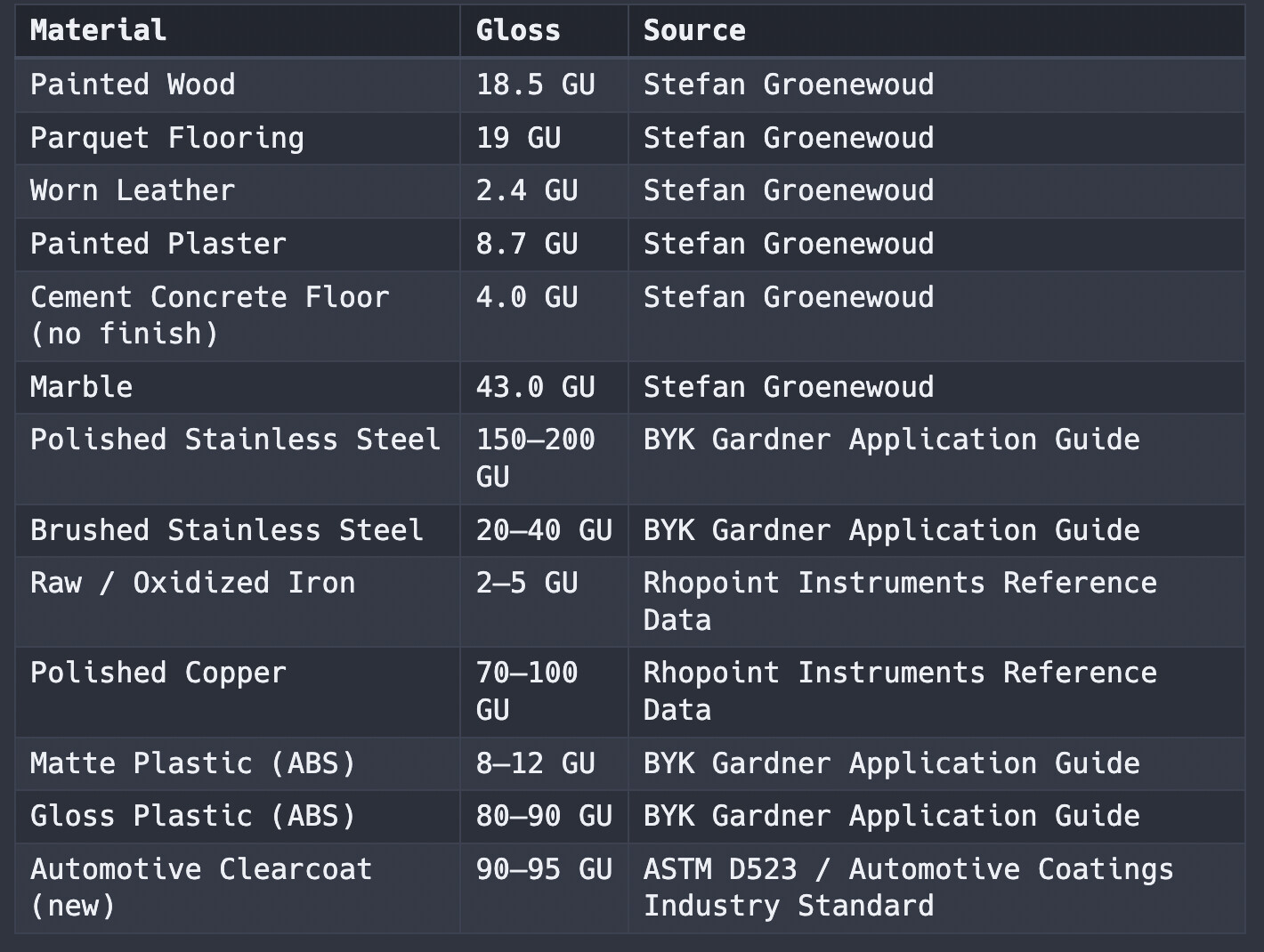
Typically, you'd grab 3-5 measurements at different positions and take the average. Use that average as the baseline for the glossiness value.
The conversion to roughness is not linear. A common approximation is:
roughness = 1 − √(gloss / 100)
That said, the exact curve depends on your engine's shading model and how it interprets the roughness/gloss input. Normalize to 0–1 first, then apply any engine-specific remapping at the end.
Material Limitations
Not all surfaces are easy to capture reliably. A few constraints worth knowing before you start:
- Curved surfaces give inconsistent readings; the meter needs flat contact with the surface to work correctly
- Heavily textured or rough surfaces scatter light too much for a stable GU value - the reading will vary across the same sample
- Transparent materials such as glass won't give useful results; the meter reads the surface reflection, not the bulk material
- Soft or deformable materials (fabric, foam, leather) are difficult to press against consistently without distorting the surface
- Very dark surfaces near 0 GU are hard to differentiate from each other - small measurement errors become proportionally significant at the low end
For those cases, visual reference photography and cross-polarized capture are a better approach than trying to force a GU reading.

My Setup
Have I used a gloss meter in my work? Not yet in a professional capacity. I have been planning to do it for a while, but not all projects allow time for experimentation. I did buy one and have been measuring different values, but I haven't been as organized or consistent as I'd like in capturing the actual material source alongside the measurements.
Ideally I'd pair each measurement with a cross-polarized photo - this eliminates the specular highlight and captures the true diffuse/albedo of the surface, which is otherwise hard to isolate with a standard camera. Cross-polarized setups require two polarizing filters (one on the light, one on the lens, oriented 90° to each other) and are effective and are not portable. An albedo capture device would be even more accurate, but those are expensive, so that remains a future goal.
How to Build a Reference Library
Pick a wide variety of materials covering the full range from very dull to very shiny. Organize the capture consistently:
- Measure and log the GU value for each sample
- Photograph the surface - ideally cross-polarized, otherwise a controlled flat-lit shot
- Store both in a local database alongside material type, finish, and any relevant context
- Convert to roughness at the end - keep raw GU values in your database, normalize to 0–1, and apply the engine-specific conversion only when you need to use the data
© 2026 Stefan Groenewoud - All views are my own, not those of my employer.